A conversation about coming out of the drawer and writing against the current
The full interview is reproduced below and remains archived on the author’s website, regardless of the availability of the external service.
Jacek Berbeka · writer
“The word, seen from the outside.”
Conversations about writing, independence and responsibility for the word. Book reviews, press features and distinctions connected with the work.
Interview · 17 July 2025
Interview from 17 July 2025 with editor Wiktor Orzeł of Portal Pisarski, Poland’s oldest writers’ portal
The full interview is reproduced below and remains archived on the author’s website, regardless of the availability of the external service.
Mr Berbeka, for years you wrote “for the drawer”, much like the authors on Portal Pisarski. What finally made you open that drawer and show your work to the world?
JB: I was pushed into it – in the best possible sense – by the writer Paweł Heszen, a long-time contributor to the much-missed Kraków magazine “Przekrój”. About a year ago, a remarkable twist of fate brought us together. Paweł read my short stories “ZEGAR” and “PROFETA” and then told me that I had a duty to write and to speak out. Literally – a duty! He would not leave me alone after that. We became friends. So in August 2024 I launched my YouTube channel, Osobliwe Intrygujące Opowieści. The playlists group the works into categories including “Ostrzeżenia”, “Wiersze i Rzeczy Dobre” and the mini-album “Głupota/Stupidity”. English-language versions are also available, as is the German text DAS!.
What advice would you give other writers who are also thinking of coming out of the drawer and using digital platforms such as YouTube, podcasts or audiobooks to reach a wider audience? Where should they start?
JB: I am neither a well-known YouTuber nor an expert on digital platforms. I simply tried, as far as I could, to achieve a professional result there. It is difficult and enormously time-consuming if you want to maintain a high standard. I have an advantage because for many years I ran an interactive agency that worked with graphic designers, voice artists and musicians, and I can now draw on those contacts. It causes quite a bit of surprise, because none of those people knew I wrote anything at all. It is my own peculiar kind of coming out. In general, I would advise doing it with heart and with quality, or perhaps coming up with something genuinely unusual. Do your own thing and do not expect thousands of views overnight. You also need to be present on several platforms at once and across as many social media channels as possible. Do not count on making money. The competition is enormous and frustration comes easily. Try it, give it time, then assess the results.
Your prose, poems and songs are all short forms. With only a few exceptions, they take between two and four minutes to read or listen to. Do you deliberately limit the length of your work, or is that simply a consequence of the subjects you choose? What techniques do you use to plant an idea and prompt reflection in such a short space of time without losing depth?
JB: Exactly. People today do not have time for reading or for long listening. Three minutes is long enough to plant a thought – and short enough that they do not have time to run away (laughs – ed.). I do not deliberately restrict the length. I love short forms that carry reflection and a moral – in fact, that is almost the only way I write – and I prefer a text to be economical with words. I do not analyse, calculate, or consciously use any techniques; I never studied creative writing anywhere. It simply happens. At the risk of sounding immodest, I try to write what I myself would want to read with interest.
Your work tackles difficult and controversial subjects: stupidity, lies, ignorance. Is it more than reflection – is it a form of resistance?
JB: My aim is not to hand people ready-made answers or lecture them. In my work I do not take sides in disputes or conflicts. I want to provoke thought and reflection, to encourage independent thinking. Anyone who reads or listens has to draw their own conclusions, using their own reason. Independently. Not the conclusions imposed on them by the media, specialists in manipulation or propaganda machines. That is extremely difficult, because people have been working on our minds for years. Too often we become blinkered believers rather than free, independently thinking human beings. We repeat primitive, inflammatory slogans and banal shortcuts in thinking that have been planted in our heads and supposedly solve everything. We have to act if we want to change that. I believe it can be changed. I have to keep trying, especially because lately things seem to be getting worse… To put it as mildly as I can, lies, ignorance, stupidity and cynicism irritate me – especially when they come from people in power who manipulate us, as I described in “ŚLEPIEC?”. I have never been a well-behaved boy and I have always gone against the wind. I am trying, and I will keep trying until it works. I am stubborn. We cannot give up, because that simply gives lies, stupidity and ignorance a head start. Cynicism and ridicule only harden positions and improve nothing. I think the best approach is to stir reflection in the ordinary person – sometimes so subtly that they do not even notice, but something begins slowly to germinate in their mind. For me, writing is also a form of therapy: it deeply relaxes and calms me; when I write, I am in another world. Writing can also be a weapon – especially at a time when enduring values and order are turning to dust.
In the context of the independent thinking you mention, do you feel that art, including literature, has greater power today than the media or propaganda, or is this more of a David-and-Goliath struggle?
JB: I am afraid that Art with a capital A – and, to be clear, I am not referring to my own work here – is losing the battle against social media, easy recipes for difficult problems invented by propagandists, and the media’s immense power to manipulate. People reproduce the mental shortcuts they have been taught and then see the world through them. Art is further weakened by the flattening of public taste, as audiences settle for mediocrity. Give it a little more time and AI, once it has read and thoroughly analysed everything ever written, will replace writers – but also critics, journalists, singers, musicians, actors and countless other professions. There is no stopping it. Those who have resisted being stupefied will sit over a beer bought with the scraps of their universal basic income and reminisce about the good old days. Only after civilisation collapses will those left on this earth finally understand what was or was not true, and what was manipulation and a game played by elites. Human nature has always been like that and still is. I would very much like to be wrong, and I am doing everything one individual can do to prevent it. Or perhaps the world will open its eyes without a tragedy. We shall see – either way, it is extraordinarily interesting, though preferably not in the sense of the old Chinese curse.
Your latest production is something different from writing: a four-track mini-album under the shared title “Głupota / Stupidity”. Could you tell our readers more about it?
JB: I came up with the piece after writing “TO!”, where I drew attention to Roman Brandstaetter’s wonderful “Litany for Deliverance from Stupidity”. I wrote a forceful, rhythmic spoken-word warning against the virus of thoughtlessness. It is not merely a piece – it is a manifesto. There is a Polish version and an English one, both equally merciless towards reality. For those who care about sound, I recommend headphones and listening to the leading bass line; for those who care about video, there is a moving music video that I spent weeks labouring over and revising again and again. The song can be watched on YouTube both in a short, so-called radio edit and in the full version. Audio versions are also available on the major platforms: Spotify, Apple, Tidal, YouTube Music, SoundCloud, Amazon and others.
Your work draws inspiration from specific events and reflections on history. What does your research process look like, and how do you turn facts into a literary message intended to provoke reflection?
JB: Everything in “TO!” and in the song “Głupota” is, to me – forgive the quotation – simply blindingly obvious. You only have to look back and then look closely at the reality around us. I have lived a few years by now. You do not need to be clairvoyant, like my “PROFETA”, to see where this may lead. I also try to prepare thoroughly for a subject, taking into account its historical and philosophical context, sources and so on. How do I turn all that into text? Honestly, it comes “from the depths of my mind” – which is why I gave that title to my podcast series, where the texts appear in audio form.
Works such as “KAMIEŃ ZAGŁADY” combine history with science fiction. Are literary genres fluid for you? How do you combine different conventions to strengthen your message?
JB: “KAMIEŃ ZAGŁADY” combines history with mysticism, parapsychology and prophecy. The same is true of the slightly tongue-in-cheek “KONIEC ŚWIATA”, although it has a serious ending – I could not let the Russian president off the hook, and Trump had not yet shown his true face at the time. I enjoy playing with words, as in “HOMONIM”, and with genres. I love mixing historical fact with fiction; sometimes I add a pinch of parapsychology and, quite often, a divine spark. All the places I describe are real, and many of the episodes I use are authentic, difficult as that may be to believe – for example, the birth of a child with two faces, four arms and four legs in “KONIEC ŚWIATA”.
What is the greatest challenge for you in the creative process, and what gives you the greatest satisfaction?
JB: The greatest challenge is finding a subject to which I can add something worthwhile, something that makes a string vibrate in the mind. After that, the rest usually unfolds on its own. One text often leads automatically to another. The satisfaction comes from the response: comments on YouTube – which I encourage and ask everyone to leave – and, surprisingly, even hate, most of it after “TO!”, “KOBIETY” and “ŚLEPIEC?”. It means something has got through, and that is exactly the point. I was enormously pleased when someone, after reading or listening, said: “that is pure Jacek Berbeka”. Then I know I have managed to develop a recognisable style of my own.
You write prose and poetry as well as songs and spoken-word pieces. Are there subjects or emotions that naturally gravitate towards one of those forms? How do you choose the form for a particular idea?
JB: Most of my prose is in the YouTube playlist “Ostrzeżenia”. I have a tendency towards defeatism – or perhaps it is the world that has a tendency towards dystopia? The text “TO!” and Roman Brandstaetter’s brilliant “Litany for Deliverance from Stupidity”, which it invokes, gave rise to another text, and on an impulse I decided to make something in the form of a song/spoken-word piece: “Głupota/Stupidity”. A moving music video completed it. I think that musical form was ultimately a one-off, because it cost me too much health. I had to learn a huge number of new things at breakneck speed, and for three months I completely lost my sense of time and reality. Then again, a four-track mini-album in two languages was a fairly ambitious plan. I have spent the past month getting back into balance. Poetry, by contrast, is an escape – away from defeatism and towards poems and “RZECZY DOBRE”. From doggerel rhymes to more ambitious poetry. Sometimes even I am surprised by the form my writing takes, as with the archaic language in “ZARATUSZTRA II” or “SKRYBA”.
Do you have a favourite form of expression, and why that one?
JB: Short, unconventional, economical short stories with a moral that prompt reflection – ideally with a surprising ending, as in “DAR”. Because I simply like that form very much and, in my view, it is particularly well suited to making people think today.
You mention Roman Brandstaetter’s “Litany for Deliverance from Stupidity”. Are there other writers or artists who inspire you to use particular forms, such as spoken-word performance?
JB: I love reading and I deeply regret the decline of reading. I do not have a particular set of writers who inspire me – although, forgive me, I will say “modestly” that I would like to write like Ernest Hemingway (laughs), only in shorter forms… but perhaps that will have to wait for another life.
So are you trying, on your own, to change the modern world with words?
JB: Look around. We see a world sinking into chaos, in which more and more people are losing faith in the point of taking action. They feel that an individual has no agency left, that one person can change nothing. But that is not true. It never was. Remember August 1980, when small, individual acts of courage came together into a force capable of bringing down a powerful system of evil. Even before August 1980 – as early as 1978, and again after the Soviet intervention in Afghanistan in 1979 – Jacek Gwizdowski, my schoolmate from Secondary School No. 9 in Kraków, and I spray-painted hundreds of anti-Soviet slogans and drawings on walls around Kraków. Maciej Miezian, a Kraków art historian, later described this as the beginnings of graffiti in our city. Each of us is only a tiny grain of sand and means nothing alone. But if there are millions of us, we can pour silently and inexorably into the gears of evil. We can grind to a halt this brutal machine of lies, ignorance and stupidity. I ask everyone: let us believe once more, and together we can change the world. A spark may once again come from Poland, powerful enough to overturn the order of evil and reduce it to dust – through all of us. We do not need a great revolution; that will happen by itself. We need an awakening and broad social engagement. And that begins with one thing: reflection and independent thought, leading to the right choices. After that, things will start moving…
What has your experience been of building a community around “Osobliwe Intrygujące Opowieści”? Do you see your texts genuinely prompting reflection and discussion in the way you hoped?
JB: I encounter two kinds of response. The first is a black hole. Some of my friends simply fell silent, and to this day I do not know whether, when they found out I write, they decided I had gone mad, disliked it, or perhaps had no idea what to say because I was stirring up a hornet’s nest. It is a pity, and I will probably never know, although it fascinates me. At the opposite extreme are reactions such as: moving, thought-provoking, reflective, keep going. That gives me strength and inspiration. So when I see something I like myself – your “Dzienność” fan page, for example – I give feedback. It can matter to a creator. What worries me is that services such as YouTube are increasingly focused on monetisation and advertising revenue, just like social media: if you want to be on top, you pay. The millions of views go to young women in cars lip-syncing to familiar hits, or videos of an industrial metal grinder pulling in a worker, or a car driving into a crowd. O tempora, o mores! While people are being stupefied and wasting their time on idiotic videos, politicians around the world are happily feathering their own nests.
How important is the positive response from such established figures as editor Wojciech Mann? Does it motivate you to keep working?
JB: It means a great deal to me. I am grateful to Mr Mann for taking the time, entirely of his own accord, to write about me and for his sarcastic comment that anyone who thinks everything is fine should read “TO!”, then read it again, and if that does not help, read it once more – and keep going until it finally works. Coming from such a respected personality, that is tremendous praise. It gives you wings. The sad fact, though, is that Mr Mann is a voice crying in the wilderness and nobody else with a large audience seems willing to help. It is especially frustrating when emails go straight into the bin without anyone clicking the attached link, and then in conversation somebody assures me they listened. Dear friends, YouTube shows every click in its detailed statistics. It is a shame that people with enormous reach often see no further than the end of their own noses, or are afraid to stick their necks out, while on online platforms clickability is God. A writer cannot compete with clickbait. But I am not giving up – sharing Bond’s initials comes with obligations!
It seems to me that your texts are not only retaining their relevance, but increasingly reflecting the reality around us. Thank you for the interview.
Wiktor Orzeł - Portal Pisarski
Interview · March 2026 · pages 24–25
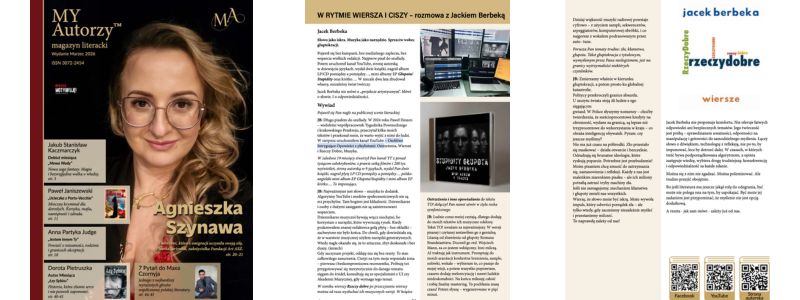
Interview for My Autorzy Literary Magazine, March 2026 (pp. 24–25), titled “IN THE RHYTHM OF POETRY AND SILENCE – a conversation with Jacek Berbeka”
The word as a spark. Music as a tool. Resistance to głuptokracja.
The editors of “My Autorzy”: The word as a spark. Music as a tool. Resistance to głuptokracja.
He appeared without a campaign, without media backing, without the support of major editorial institutions. At first, he wrote for the drawer. Then he launched a YouTube channel, an author website in nine languages, published two books, recorded the LP/CD album pomiędzy a pomiędzy…, and the EP mini-albums Głupota/Stupidity and krótko…. In less than two years, he built an independent creative world of his own.
Jacek Berbeka does not speak of an “art project”. He speaks of the word. And of responsibility.
You appeared suddenly on the public literary scene.
JB: I wrote for the drawer for a long time. In 2024 Paweł Heszen – a long-time contributor to Tygodnik Powszechny and Kraków’s Przekrój – read several of my texts and persuaded me that they were worth bringing to the public. In August I launched the YouTube channel Osobliwe Intrygujące Opowieści, with playlists titled Ostrzeżenia, Wiersze i Rzeczy Dobre and Muzyka.
In just 19 months you created a YouTube channel with more than a thousand subscribers, almost a hundred videos and 200,000 views, an author website in nine languages, published two books, recorded the LP/CD album pomiędzy a pomiędzy…, the Polish-English EP mini-album Głupota/Stupidity and the EP mini-album krótko…. That is impressive.
JB: The word matters most – music is an addition. YouTube and social-media algorithms are not kind to me. Clickability is their god. Journalists and people with large audiences are not interested in supporting me.
JB: Music journalists can even be openly reluctant, because I use tools that are turning the market upside down. Once I gave a well-known editor a bare disc – no cover – and she could not stop praising it. Until she found out I had used generative tools in the musical layer. Suddenly it was artificial, too perfect, soulless. (laughs) When I begin a project, I give myself to it completely. It is a state of total immersion. My wonderful wife suffers for it – she is my first and most uncompromising reviewer. I also try to prepare properly for each subject: I go back to sources and consult specialists at the Jagiellonian University or the Academy of Music whenever the subject requires it.
In the poetry collection Rzeczy dobre, readers can listen to musical versions of the poems immediately after reading them. In the book Ostrzeżenia i inne opowiadania, you even added a symphonic-rock piece to the text TO!.
JB: People read less and less, so I add musical versions to my texts. I consider TO! my most important piece. In both the written and spoken versions I set it alongside Roman Brandstaetter’s brilliant Litany for Deliverance from Stupidity. Editor Wojciech Mann appreciated it, for which I am grateful. Others remain silent. I treat AI as an instrument. For my arrangements I prompt for specific sounds, samples, solos and vocals; I choose what fits my vision, then I correct everything, sometimes adding spoken-word delivery and even human imperfections. At the end I mix it all and do the final mastering. It takes an enormous amount of time. And then I hear: “generated in five minutes”.
JB: Today, most radio music is made digitally – with samples, sequencers, arpeggiators and computer processing, and, worst of all, vocals polished with Auto-Tune.
You tackle difficult subjects: evil, lies, stupidity. Your text Głuptokracja, built around the neologism you coined, pushes some readers almost to their limit.
JB: We are heading towards głuptokracja, and then straight towards global catastrophe.
JB: Politicians have crossed the boundaries of absurdity.
JB: At the top of the world stand bad people with egos that reach the stars. In Poland we hear nonsense – for example, claims that six-per-cent defence loans spent abroad are better than three-per-cent loans that can be used domestically – which insults the intelligence of citizens. I ask: are we still thinking?
JB: There is no longer time for half-measures. Evil has stopped disguising itself – it operates openly and brazenly. Brown-shirt ideologies are returning and gaining support. We need an awakening. Through my writing I want to force people to stop, think and reflect. Each of us is a tiny grain of sand – but millions of grains can jam the gears of the machine of evil.
JB: If we do not react, the machinery of lies and stupidity will grind us all down.
JB: I believe the word can be a spark. It can trigger an impulse capable of overturning the order of evil – but only if we begin to think independently and stop remaining silent.
JB: It really does depend on us.
The editors of “My Autorzy”: Jacek Berbeka offers no comfort. He provides neither easy answers nor safe subjects. His work is a test – of attentiveness, resistance to manipulation and willingness to think independently. He combines the word with sound and technology with reflection, not to impress, but to reach further. At a time when content is often subordinated to algorithms and opinion replaces knowledge, he chooses the harder path: consistency and responsibility for every sentence.
You may disagree with him. You may argue with him. But it is difficult to remain indifferent.
Because if literature still has a role to play, perhaps that role is not to soothe. Perhaps its task is to remind us that thinking is not an optional extra.
And the rest – as he himself says – is up to us.
Reviews
Two substantial reviews of the book, reproduced in full.
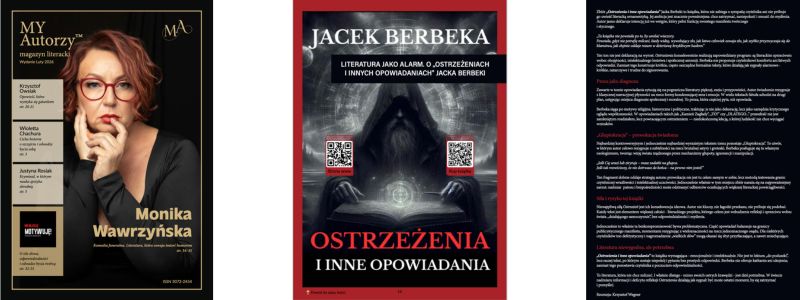
Review by editor Krzysztof Wegner.
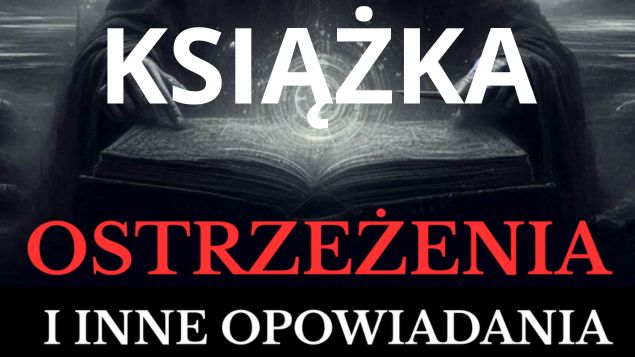
Review published by the portal “Nie czytasz? Nie idę z Tobą do łóżka.”
Jacek Berbeka’s collection “Ostrzeżenia i inne opowiadania” is a book that does not court the reader’s affection or try to seduce with literary ornament. Its ambition is far more serious: it wants to stop the reader, unsettle them and force them to think. The author states that intention clearly in the introduction, which serves as a kind of creative and ethical manifesto.
“This book was not written to make your evenings more pleasant.
It was written because I cannot remain silent when I see how readily people become accustomed to evil, how quickly they grow used to lies, and how willingly they lease out their reason to loud slogans that breed evil.”
This tone is no empty declaration. Ostrzeżenia consistently delivers on the programme it announces: it is a literary protest against indifference, intellectual laziness and social amnesia. Berbeka offers the reader neither comfort nor easy answers. Instead, he builds short, often formally spare texts that work like alarm signals – brief, insistent and difficult to ignore.
The stories in the volume stand on the border between fiction, essay and parable. The author consciously gives up conventional narrative flow in favour of a form that condenses meaning and emotion. In many pieces, plot moves into the background and gives way to social and moral diagnosis. This is prose that asks more often than it tells.
Berbeka draws on religious, historical and political motifs, not as decoration but as tools for critically examining the present. In stories such as “Kamień Zagłady”, “TO!” and “DLATEGO...”, the past is not a closed chapter but a recurring warning – an unfinished lesson from which humanity refuses to learn.
The most controversial and, at the same time, the most distinctive text in the volume is “Głuptokracja”. Here the author deliberately abandons subtlety in favour of brutal satire and grotesque. Berbeka uses his own neologism to create a vision of a world governed by mechanisms of stupidity, ignorance and manipulation.
“If it offends or irritates you, you have the makings of a fool.
If it makes you so furious that you cannot finish it, you definitely are one!”
This passage neatly captures the author’s strategy: provocation is not an end in itself, but a way of testing the limits of the reader’s sensitivity and intellectual honesty. At the same time, this is where the collection exposes itself to its most serious criticism: the excess of pathos and directness may deter readers who expect greater literary restraint.
The undeniable strength of Ostrzeżenia lies in its ideological consistency. The author does not hedge, soften the message or try to please. Each text forms part of a larger whole – a literary project designed to provoke reflection and resistance to a world that “runs by itself”, without responsibility or thought.
At the same time, that very uncompromising quality can become problematic. Some stories hover on the boundary of the journalistic manifesto, at times giving up ambiguity in favour of unequivocal judgement. For some readers, the defeatist tone and accumulation of “big words” may prove too overwhelming, or even discouraging.
“Ostrzeżenia i inne opowiadania” is a demanding book, emotionally and intellectually. This is not bedtime reading; it leaves the reader with unease and questions for which there are no simple answers. Berbeka offers neither catharsis nor consolation. Instead, he leaves the reader with a sense of responsibility.
This is literature that refuses to remain silent. And that is precisely why, despite its sharp edges, it is needed today. In a world of information overload and a shortage of reflection, Ostrzeżenia works like a signal: perhaps this is the last moment to stop and think.
Review: Krzysztof Wegner
Not to frighten, but to awaken.
To warn before it is too late again.
The book contains seventeen distinctive, economical short stories with a moral, all designed to provoke reflection. Many lead to a surprising ending. These are human stories for inhuman times: full of defeatism, contemplation and, at moments, black humour, relentlessly compelling the reader to think. Beginning with the author’s incisive foreword, we find ourselves thinking intensely about a world that is cracking quietly – without thunder or archangels’ trumpets, but with our silent consent.
In “Profeta” and “Nieumarły”, the question resounds: what is the point of warning a world that refuses to listen?
“Kamień Zagłady” is a journey of a mythical stone through the centuries, partly grounded in historical fact – a story of an ancient evil that infects, and of memory that fails.
The “end” of the world arrives without fireworks, like an ordinary news item: an ordinary day, ordinary indifference and silence just before time itself runs out.
“Ślepiec” reveals the paradox of seeing more than others despite having no sight.
“TO!” works like an alarm: insistent and disturbing, refusing to let you sleep as images flash beneath your eyelids of a world wounded by evil, lies, hatred and the convenient thought, “it does not concern me”.
“DLATEGO…” is a cry built from the silence of victims and from indifference, an accusation directed straight at all of us.
Then comes “Głuptokracja”, a bitter, mocking parable in which the smile dies on the reader’s lips because just beyond the threshold stands a reality they recognise.
The religious stories “Zaratusztra” and “Skryba” reach back to the sources of faith. The first conveys a truth about free will and the eternal struggle between good and evil; the second tells of the price paid for asking a forbidden question about the duality of God.
“Zegar” asks about the nature of time. “Chciwy” and “Filmofil” show loneliness as the consequence of choices. “Dar” touches on parapsychological possibilities that remain unrecognised.
The autobiographical, fact-based “Everest” is unexpectedly captivating: a story about love of the mountains, the price of passion and the limits of human endurance.
The book closes with “Kobiety” and the more restful “Miłość”, which explains how to care for that extraordinary feeling.
Each story is like a sign scratched into the darkness, reminding us of the evil that returns, the stupidity that grows stronger, and the indifference that kills as effectively as violence. This is dense, merciless prose in which prophecy intertwines with reality, history casts light on the future, and the sacred mixes with brutal realism. The author offers no comfort: he makes us stop, reflect and look into a mirror that holds the face of modern humanity and the modern world.
“Ostrzeżenia i inne opowiadania” is a book that leaves behind a screaming silence. Heavy. Uncomfortable. A silence in which one question begins to form: are we still thinking, or are we merely allowing everything to keep happening “by itself”? It is a short and important must-read, one after which the world might move in a better direction if people could once again read attentively and draw lessons from history.
Whether that happens is up to you…
Jacek Berbeka – an author of reflective short stories, poems and songs. His work lies at the intersection of literature, poetry, spoken-word performance, music and visual art.
The principal aim of his work is to provoke reflection and denounce lies, ignorance and stupidity. His important text “TO!” received recognition from editor Wojciech Mann.
Alongside short stories and poetry, he has released the LP album “pomiędzy a pomiędzy…” and the bilingual EP mini-album “Głupota/Stupidity”.
He is also the creator of the expressive, pejorative neologism “głuptokracja”, a term describing both a political system and a social phenomenon.
Literary award · 2025
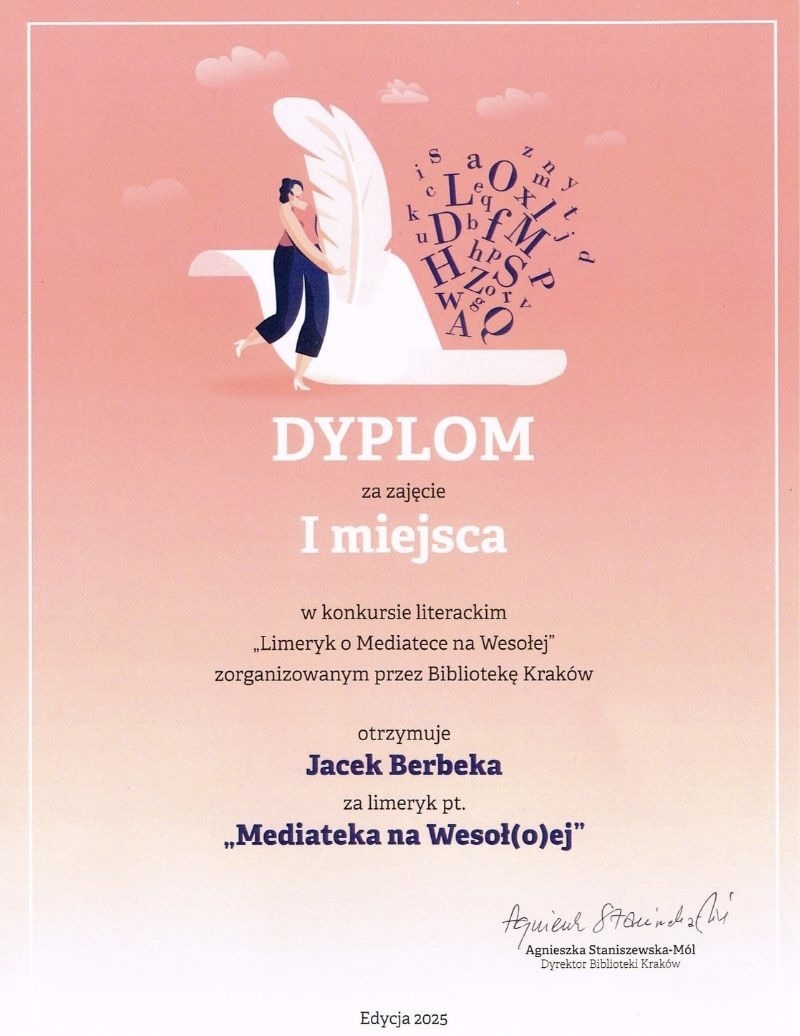
1st place in the 2025 literary competition for the limerick “Mediateka na Wesoł(o)ej”.
My Autorzy Literary Magazine · June 2026
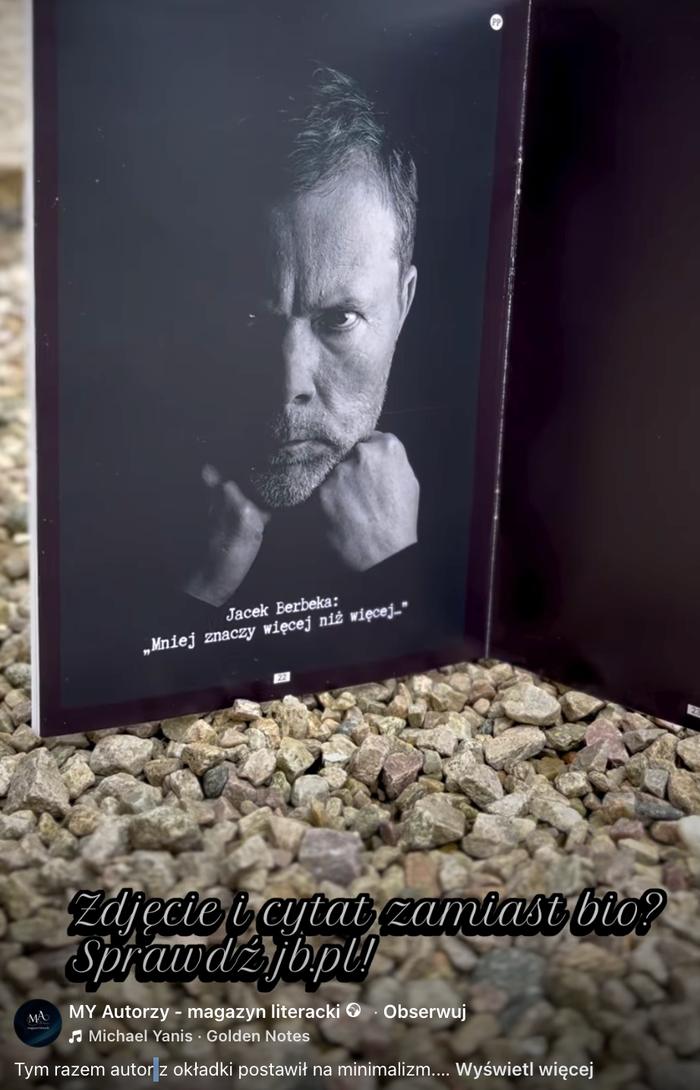
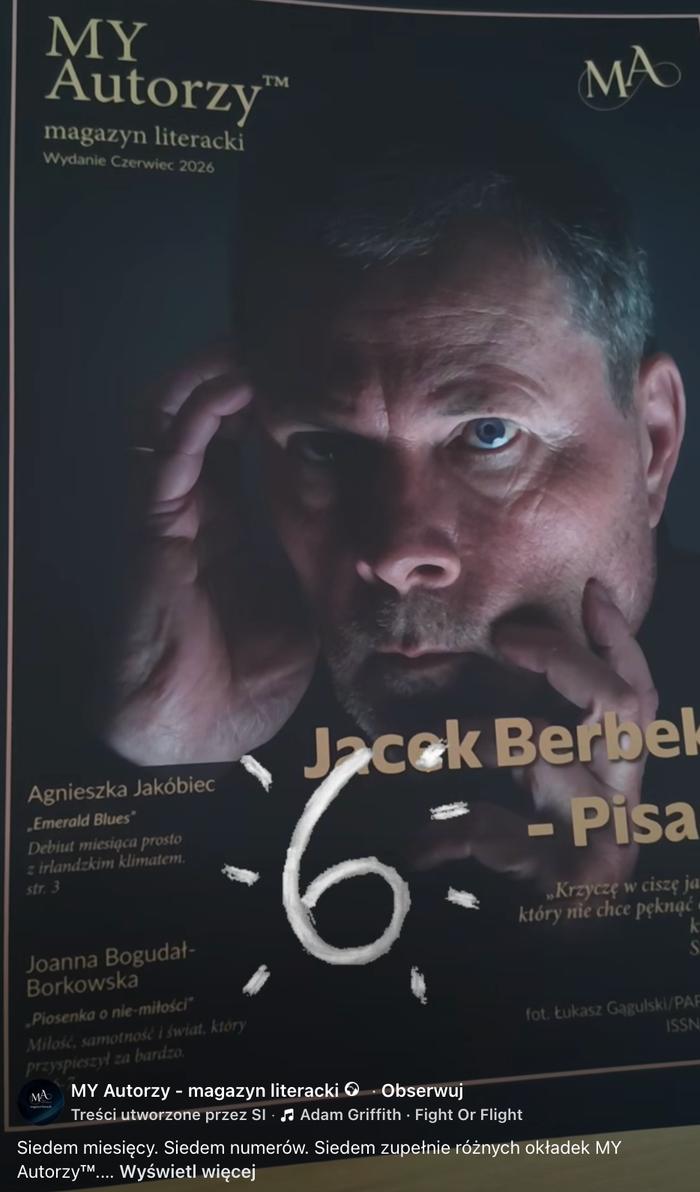
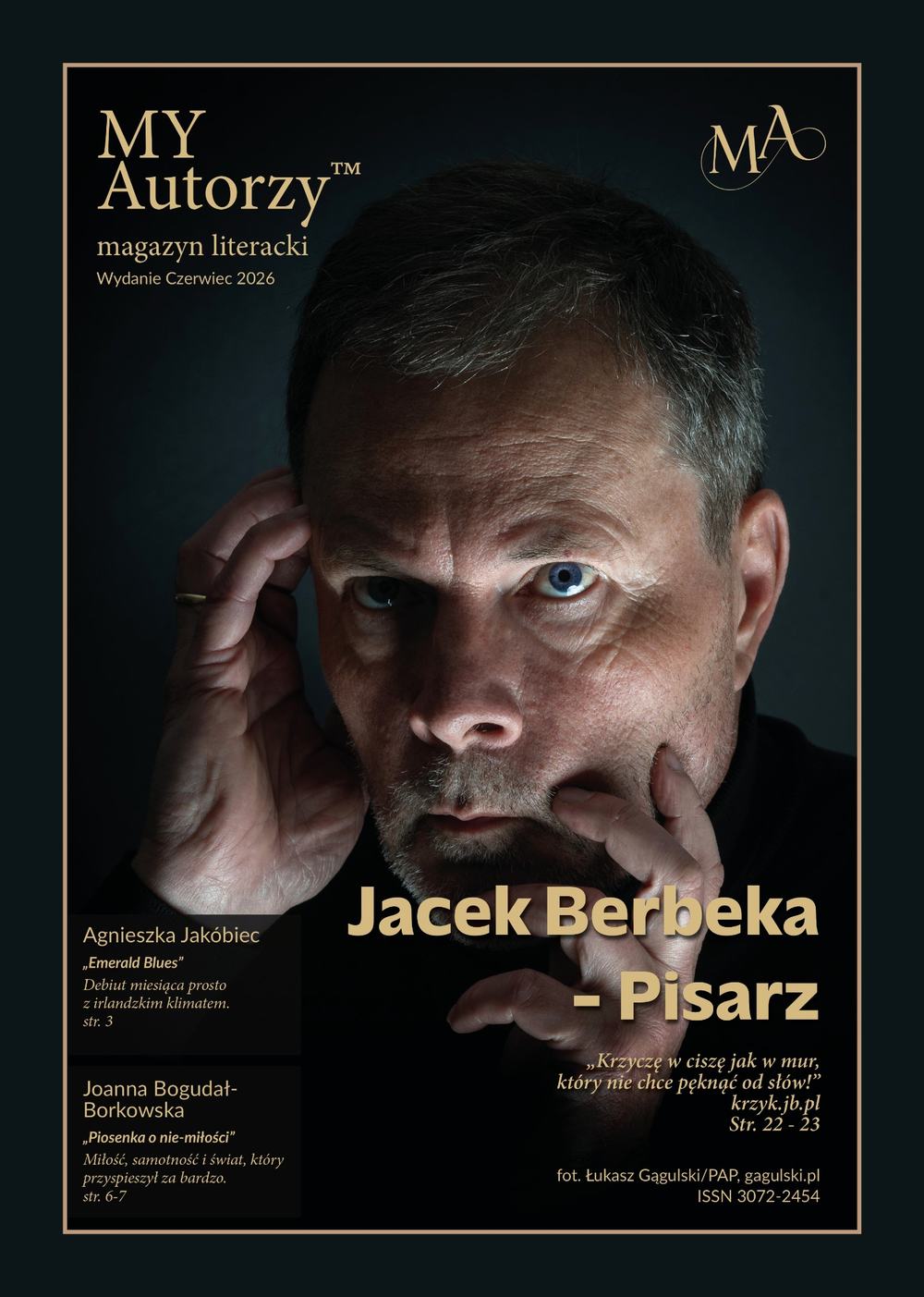
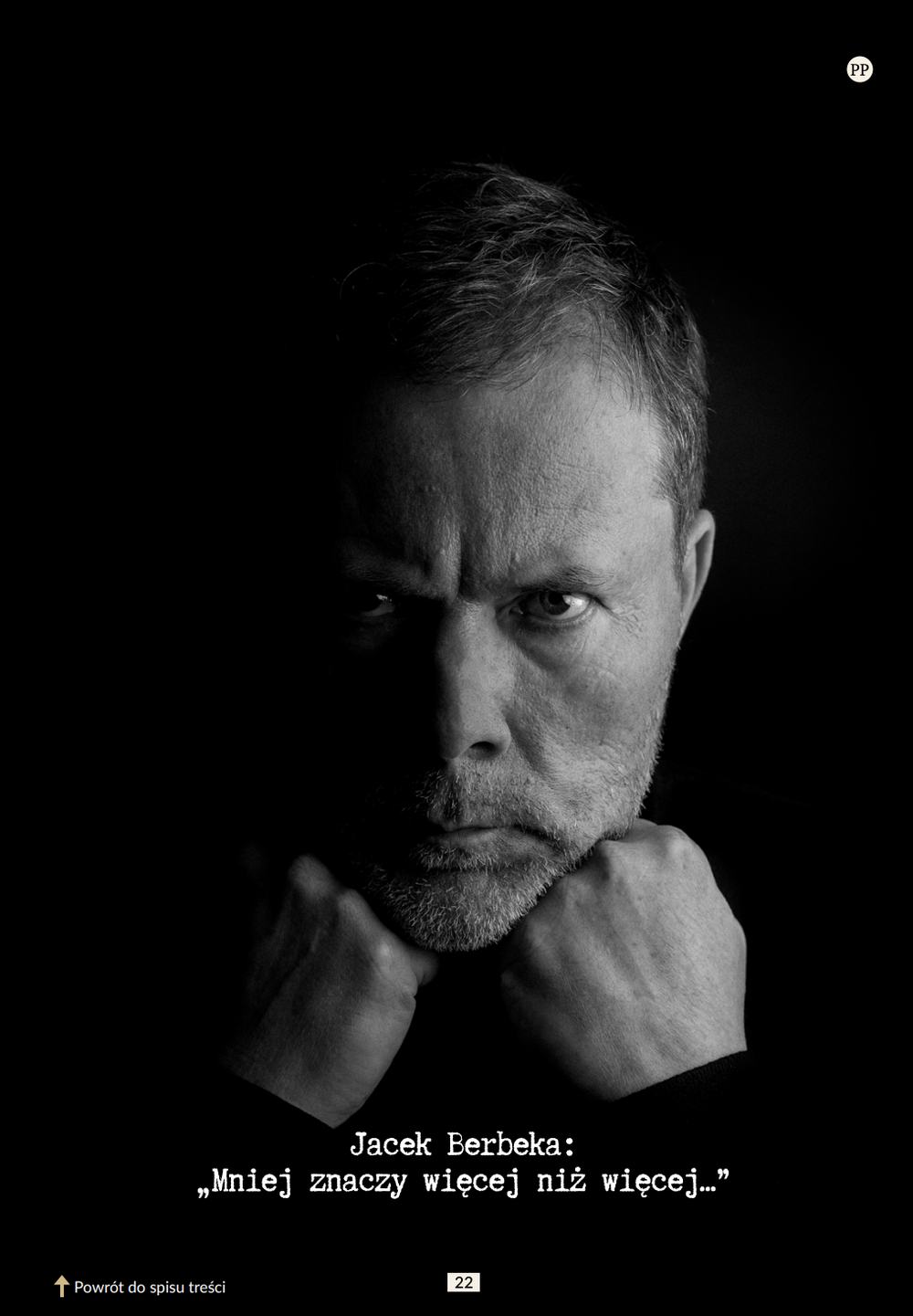
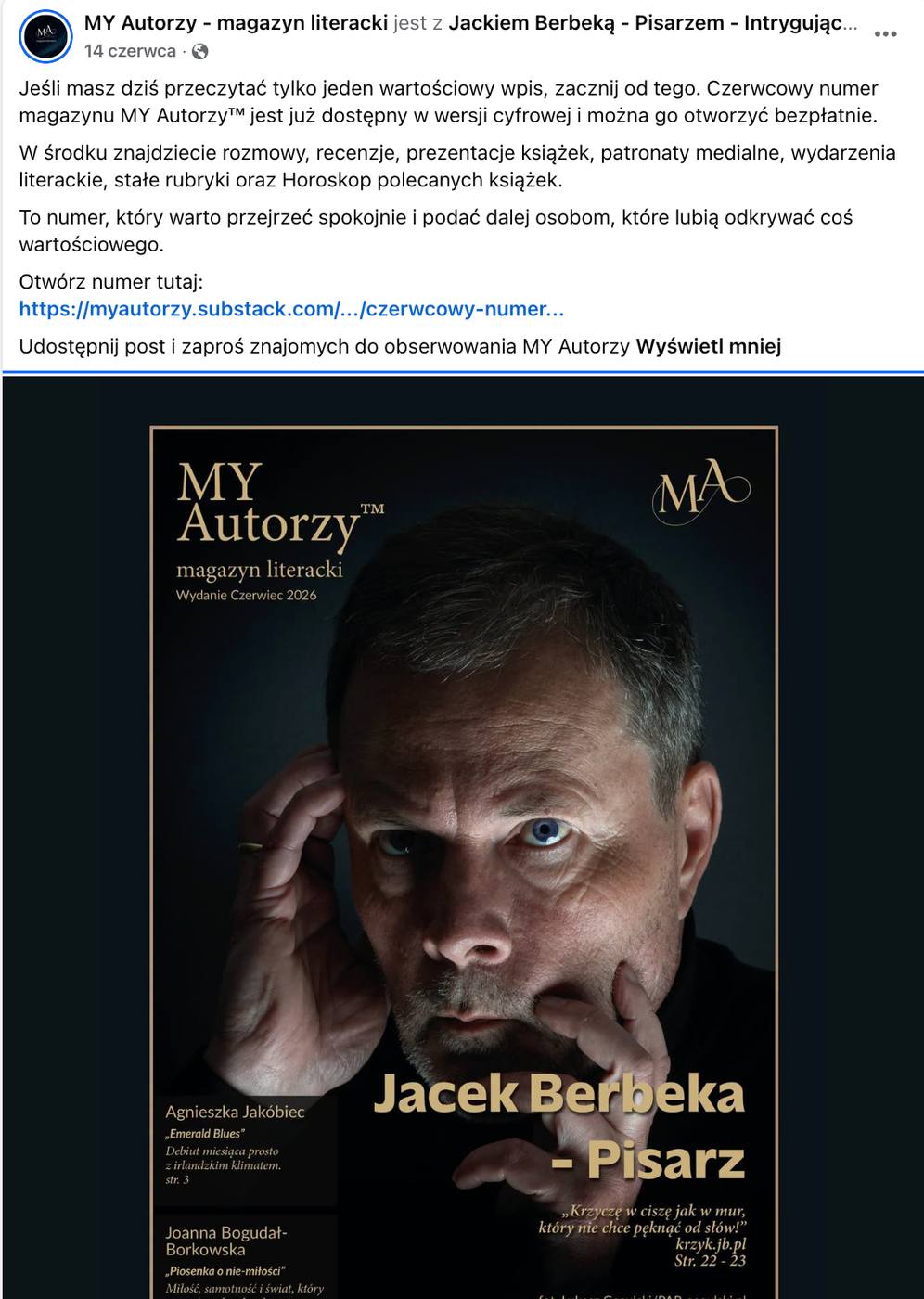
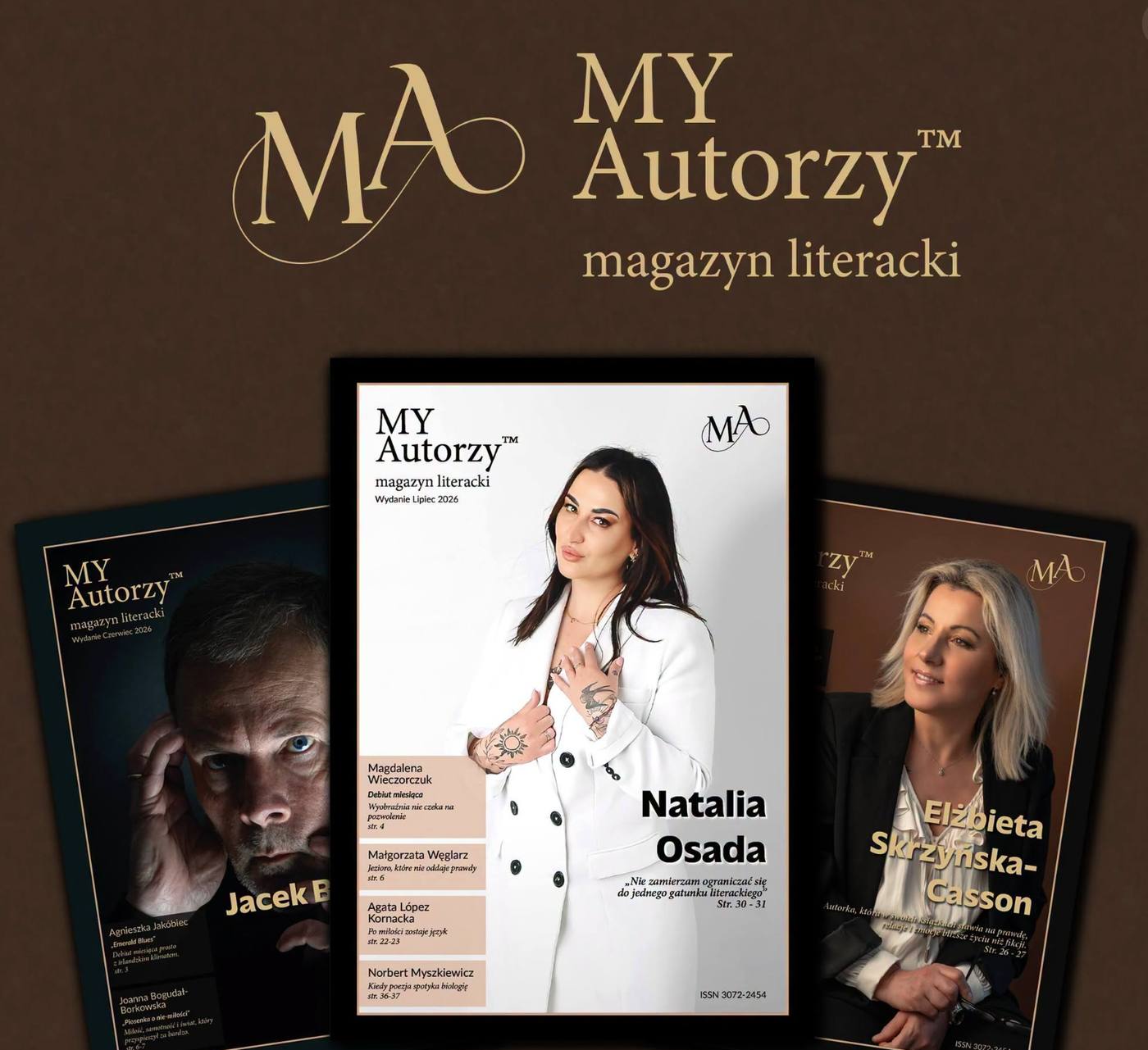
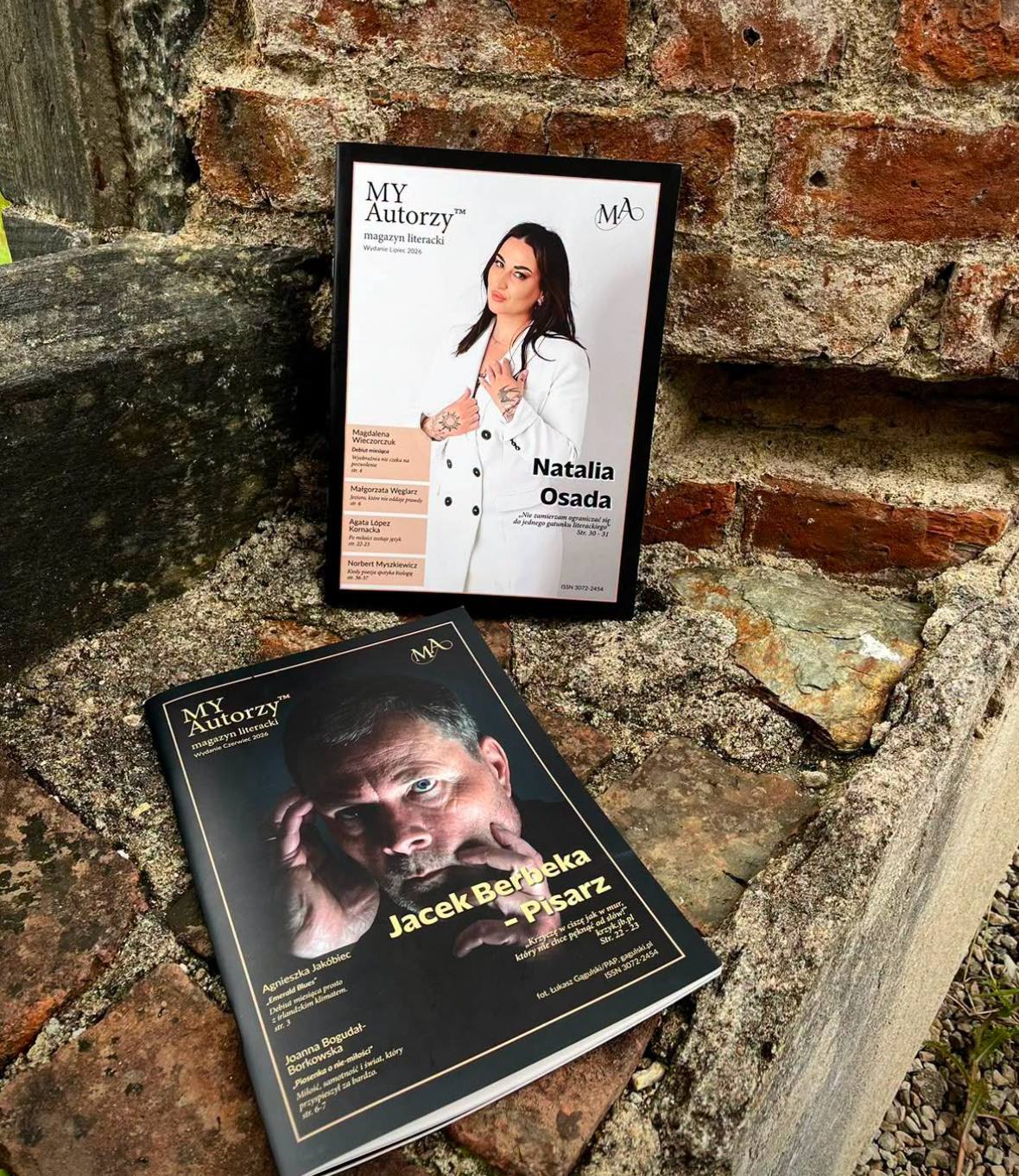
In June 2026 I had the extraordinary pleasure of appearing on the cover and on two pages (22–23) of My Autorzy Literary Magazine. Photographs by Łukasz Gągulski, PAP. I chose an ultra-minimalist form. After all, “Less means more than more”.
Video
Clicking a thumbnail opens the video in a new window.